Ultrasonic disintegration
PALMINCO’s high-performance ultrasound technology makes it possible to disintegrate biomass through hard cavitation.
The forces released by this process are capable of breaking down even the most robust surfaces.
Ultrasound is sound with frequencies beyond the audible range, i.e. from 20 kHz up to the megahertz range.
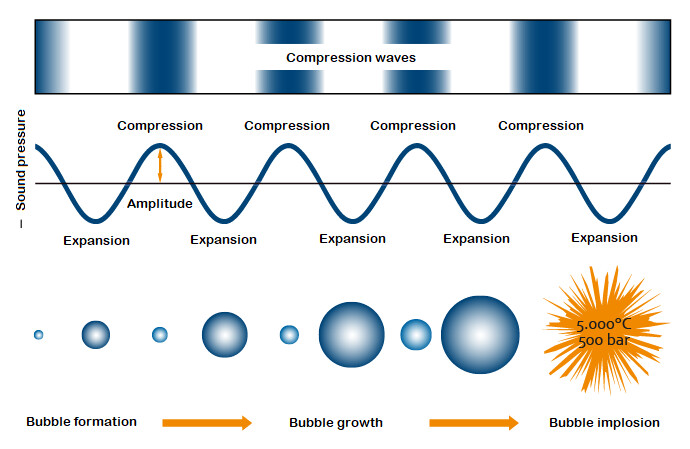
In aqueous media, ultrasound waves cause periodic compression (pressure) and expansion (tension, negative pressure) of the medium being treated.
During the negative pressure phase, high-intensity ultrasound causes the water phase to break up, leading to the formation of microscopic cavities in the liquid.
These bubbles fill with water vapour or gas. They grow during the tension phases and shrink during the compression phases until they implode.
This phenomenon is known as cavitation, a process occurring under extreme (adiabatic) conditions.
On a micro scale, this generates pressures of 500 bar and a temperature of 5000°C.
In the frequency range from 20 to 100 kHz, particularly large cavitation bubbles are generated, which produce extreme mechanical shear forces when they collapse.
These forces generated by ultrasound are capable of destroying even the most robust surfaces.
Effect on bacterial, algae and plant biomass
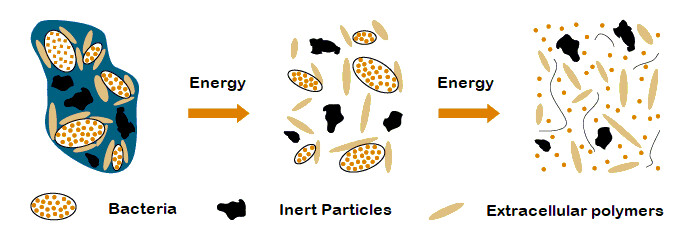
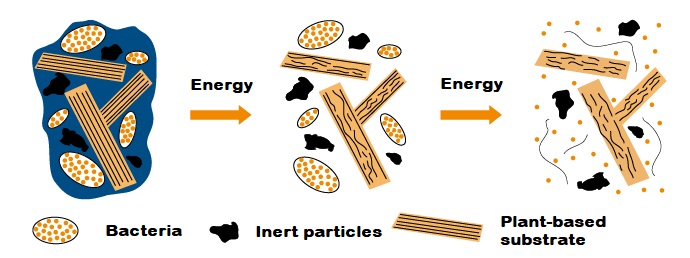
Higher-intensity ultrasound causes the biomass to break down.
Our newly developed ultrasound systems initially disintegrate biomass agglomerates within a short sonication time.
The total surface area of the biomass suspension is increased.
Continued sonication opens the biomass cells, allowing the cellular contents to escape and dissolve.
In bacterial biomass, this releases enzymes.
The sonicated biomass is more readily available as a substrate for active microorganisms and is degraded more effectively during the biological degradation process.